Friday, March 18, 2005

Ambulation

A few years ago a very well-to-do liberal (did I have to mention that?) colleague at work took an interest in my preference in shoes as they often do. She didn't think my somewhat old Sperry Topsiders were suitable to the task of, well, enclosing my feet and all those duties associated thereto.

Now I should add that the Sperry Topsiders (let's just call them "boat shoes") were not my idea in the first place. Several years prior to that I had worn some sort of "sneaker" which took the form of "running shoes" except that they had Velcro fasteners where there would have otherwise been shoe laces. Not having laces was a problem for this (oh, did I mention) other well-to-do liberal person who took an interest in my footwear. She convinced me to switch from my awful Velcro laden sneakers that I think came from somewhere like K-mart for $10 a pair and switch to these nice upscale boat shoes, complete with LEATHER shoe laces that needed to be re-tied about every 15 minutes. Not to mention I feel much safer in them when I am on a boat, that is, if I had a boat.

The cost of the boat shoes was around $75 at he time I think, which I considered excessive. But they were almost as comfortable as the $10 Velcro sneakers and eventually I got used to wearing them. I tried gluing the leather shoe laces to keep them tied, since I never used the laces when putting the shoes on or taking them off (just as I never used the Velcro on the sneakers.) All shoes should go on when you forcibly shove your feet at them and come off when you step on the back of one shoe and pull. Seems simple enough to me. Glue didn't work though, and after a few years of this, and other solutions, I took to tying the laces with square knots, so that even if they LOOKED untied, they remained snugly on my feet. Even the square knots would come undone eventually. I really don't think cow skin was designed to be used in this way. Snipping the excess off at the square knot wouldn't do since there wouldn't be anything to grip to re-tie it. I ended up just tying a series of square knots one on top of another until the top of my shoes looked sort of like an old-time Chinaman's pony tail.

Maybe that's why the more recent liberal fashion consultant thought that I should visit the Earth Shoe store and get something that (to her at least) looked nice and was comfortable too. So I did. And about $150 later I was wearing sort of brown leather clog-looking things with no laces (I liked this) and no heels (I wasn't so sure about this part). They are big up front where the toes are, and the lack of heel was supposed to cause the foot to comfortably "roll" forward as you walked.

These shoes were indeed comfortable for a few days. For some reason though which I don't recall at the moment, I felt compelled to go back to my "boat shoes" after a couple of weeks. This immediately got noticed. My excuse of "not wanting to wear the Earth Shoes out too quickly" was met with the suggestion that I buy a second pair.

I suppose many a friendship has been sacrificed over such a thing. In any event the Earth Shoes found there way here to the beach, where I am now where I thought they might serve as "dress shoes" if I ever needed such a thing (apparently I don't) and the next time I laid eyes on them the special protective spray which the Earth Shoe store salesman had convinced me was essential to proper enjoyment of the shoe had turned into some sort of smorgasbord for green mold. Nothing else in my closet was similarly affected, so I think they really did like that spray. Or perhaps they came in on it.

I've continued to wear the Sperry Topsiders, and only that brand, not just ANY boat shoe, for many years. I've had 4 or 5 pair. I wear them until they disintegrate. Well, actually longer than that, for as they disintegrate I "fix" them as best I can, applying glue here, string there, and whatever it takes to avoid the need to break in a new pair. I've even found an "outlet" store at the beach where I can get them for $50 or so, which is a fraction of what they cost now in regular stores.

All of this, preamble (word chosen carefully) to my shock and horror at seeing a pair of Earth Shoes at Walmart the other day for $15. On a whim, I bought a pair. There was no spray to go with them, and no salesperson nearby to suggest I needed any. They are made in China. I bet the pair I got for ten times as much was too. I wonder what these Topsiders actually cost to make? If I were paying $15 for them I'd be a lot more inclined to throw them away and break in new ones more frequently than I do. If this makes me a tightwad then I'm comfortable with that. I like to know what things cost to make, and that the people in between me, the consumer and those Chinamen who make the shoes and inform me as to how to tie the laces are not making too comfortable a profit.

For well-to-do liberals, money is no object, if it achieves the goal of making MY feet look better, just as personal taste is no object to those in the condo association who want everyone's door to be the same horrid orange. Those who know something about how government works, and who don't either work there, or have unlimited resources, would do well to shop for less expensive alternatives I think.

Or maybe it's just a coincidence that my last two shoe consultants were liberals.

And all of THAT as preamble to my slipping on my new Earth Shoes today and going for a walk on the beach. Spring has sprung I guess, or the 50 degree temperature and lack of wind combined for very moderate FEELING weather. That, coupled with my new shoes, and their "rolling" action and before I knew it I realized I had walked a VERY long way.

Yesterday being St. Patrick's day had a noticeable impact on the beach. Or at least I guess that's what did it. This place is deserted this time of year and it's common to not see another single soul on the beach or any sign of humanity. From the parking lot, and noises in the distance I infer that some are making a long weekend here out of St. Patrick's day, one of the many holidays that I can be blissfully unaware of unless it is brought to my attention. Oh yes, I was careful to get off the streets early yesterday and really had forgotten all about it until I noticed all the tire tracks on the beach. It seemed that every dune crossing had been the site of drunken celebrants testing their four-wheel-drives. Quite a few had apparently brought wood with them to half burn for warmth in the night and then quickly cover with sand until the flame was gone, or not.

I wasn't consciously paying that much attention to the tire tracks or the burnt wood so much as the things uncovered by last nights activity. Due to my eyesight being no better than average for a person my age I tend to collect mostly brightly colored or large things on my beach walks. I'm sure many a tiny treasure has escaped my notice.
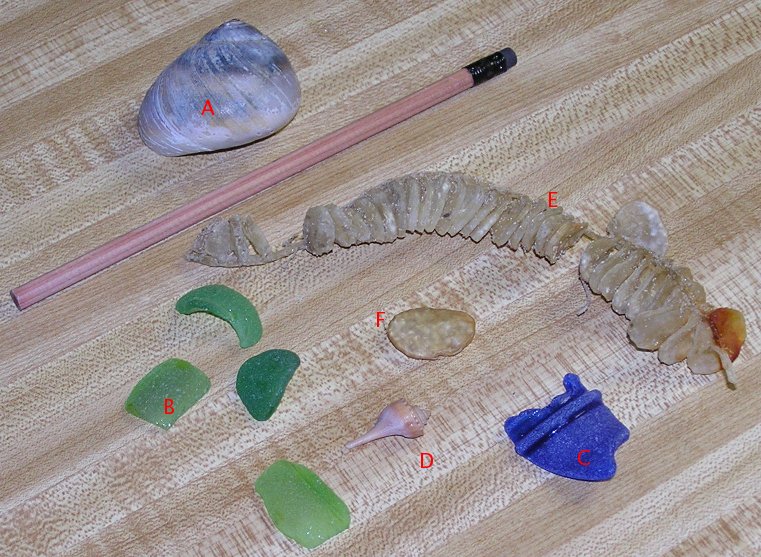


As a result, a large snail shell (A) that isn't broken will usually get my attention. The ones found here are not often very attractive, although with some oil and a bit of work they can be made to be quite decorative. Since attending a lecture on the subject broken bits of glass (B) are now picked up by me rather than being passed over. Some people actually SELL this stuff making an old Heineken bottle carelessly tossed into the ocean a modern investment vehicle. I used to think that such glass was worn down mainly by the action of sand, but I learned that salt water actually weakens the structure of molten silicon dioxide (and whatever else they happen to mix with it) accelerating the speed with which those razor sharp edges become harmless, and rendering a Noxema, Haley's MO, or some fancy new fruit drink's bottle (C) difficult to distinguish and giving the glass surface a patina hard to duplicate by mecchanical means. Of course, at the lecture I attended, I found that through proper chemical and spectroscopic analysis one can trace these glass fragments back to their source, be it a modern day bottling plant or a hand blown item from the 1600s (none of which appear in my collection I am sure.)

In fact I often note that the beach is one of the few places that you can safely walk barefooted without much concern. Almost anything except a discarded hypodermic needle is quickly rendered safe to the bottom of the feet in one way or another. Most things submerge themselves in the wet sand at a uniform rate so that if you "relax" your feet (I'm not entirely sure I know what I mean by this) you can walk down the beach without looking where you are going and only occasionally feel something uncomfortable enough to make you check for skin breakage. Almost any metal corrodes rapidly to the point where it is unrecognizable. There is no such thing as stainless steel here. Only gold has much chance of surviving in a recognizable form and I have yet to collect my first dabloon. Wood rots in interesting ways and plastics of all sort may last, but they are quickly covered with sea plants, snails, and other mollusks to the point where you might recognize a familiar shape without being able to see any of the original surface. No, my feet are safe as I amble down the beach this time of year in my Earth Shoes. I have absolutely nothing to worry about.

That is, other than crushing something I'd like to collect (D) like this tiny conch shell about whose inhabitant we can say "We hardly knew ye." As the sand protects our feet from sharp things, it also protects items such as this from multi-ton drunk-driven ersatz dune buggies on St. Patrick's day nights. Our tiny departed conch friend is indestructible by comparison to it's former lodgings (E) which I have seen on the beach frequently thinking it is some sort of washed up plant. But actually I found that these are conchs egg casings. Normally I find these totally empty with a small hole on the outer edge where the young ones have left. Close by to this one however I found a separated unit (F) with no such hole, and not one, but many tiny unborn inside, shell, and all.

The conch, like the snail, of course, makes do with only one foot, albeit the majority of its body serving that purpose, and has no need of an Earth Shoe, or a boat shoe for that matter.

When one walks, one thinks, and without knowing it finds that they have reached the public beach in Delaware with a pocket full of treasure and a seemingly long (now) slog back to that speck in the distance called home. One can but try to get back before damage is done to those collected beach goodies and thoughts.

Making up for months during which I mostly cut and pasted excerpts and my quick reactions to things "collected" on the Internet it occurs to me that the quality of such "blogging" isn't far above the time wasted watching TV. It is nice then from time to time to actually create something, especially as I sit here and realize that those shoes have rubbed a small blister onto the inside of my right foot.

I should go now. I have an "Urgent" message from Sears, informing me that they are all out of the money I gave them to insure I'd never have to have a kitchen appliance replaced. It occurs to me now that Sears gets my money if something breaks, and they get my money if it doesn't too. There is something of the "Earth Shoe" phenomenon in this that I'll have to study more carefully. Look for an update.

Update: Well, I'm here adding tags to my old posts. I noticed I promised an update, so here it is. I let all my Sears extended warrantys expire. Most of this stuff costs about twice as much to replace or insure as to fix, plus, in replacing them you usually get new features, energy efficiency, etc. Also, I'm still wearing the Waolmart Earth Shoes. They don't ever seem to wear out. They smell a bit though. So I throw them in the washing machine from time to time.

Sunday, February 20, 2005

Joel on Software - Thursday, February 17, 2005

Joel on Software - Thursday, February 17, 2005: "So far, it looks like this is a nifty program, and consumers should be happy that Microsoft has announced it will be free, but it really, really would have been nice for us here in the software industry if Microsoft had set a price on this thing just to provide some air cover for the other companies working on spyware removal. This is not a software category where a monopoly monoculture will be a good thing."

Ah, but this is the beauty of the thing. The same company that flooded the world with this poorly designed bloated bag-o-crap needs to hit another home run, and it's the bottom of the ninth and all their best hitters have struck out as mighty Bill wheezes up to the plate...

"HEY... let's tie another wagon to the cash cow!"

And as what's left of Norton and Macaffee hurl themselves from the burning superstructure we watch it sink into the tar pit as MS corporate management are hanged by their private parts from the mizen mast.

err, or something.

Anyway, this whole notion that Microsoft must fix the bad design of Windows by adding more software, free or otherwise, on top of it is a major admission of failure, one of several, inability to support multiple hardware architectures quickly being the other one that comes to mind.

Like the mangled mass of metaphors in this post, Windows can't be fixed, and the egos at Microsoft won't let it be re-written. Apple use will continue to grow, as will Linux, and there will be a continuing trend back to server-centric computing that will make the outcome of the OS wars less interesting anyway. Can Microsoft succeed in a competition for on-line storage and services? Do they have the courage to buck Intel and start coding for radically new processors? Can you spell "Razor thin profit margins"?

Well, of COURSE you can NOW. Anyway, this is all fun to watch from the vantage point of never having to boot Windows again. The longer the agony lasts the better.

I don't think I should add future posts right after watching epic movies such as Return of the King.

Friday, February 18, 2005

New Apple Notebook and SL

Haven't updated this for a while, but I answered an inquiry in the forums recently about laptop recommendations. Since I recently got a new Apple Powerbook it seemed like a good opportunity to brag...

The 12-inch model I got probably isn't optimum for running SL, but it does rather nicely. I wanted something small, no noise, no heat. I almost just got one of the new Mini's, but they only have 32M video ram, and my old Compaq could go at any minute so I thought another laptop/desktop-replacement-style might be better. The 12-inch model (well the new ones anyway) will run an arbitrarily large external monitor AND the built-in monitor at the same time in dual-head mode so I no longer need a 2-PC switch to run SL in full screen mode and still do web browsing etc. My external monitor (a Compaq as a matter of fact) has both analog and digital inputs and the Powerbook supports both.

The Apple OS is also quite compatible with Linux systems, so I can open up an X-window and run Linux applications remotely too, so, after I get used to this, I think I can give away my KVM switches... the never-ending transition from PS/2 to USB to wireless I/O devices making them rather hard to deal with anyway.

For LESS money I could have gotten one of those desktop-sized G5 systems which I'm sure do a better job of SL...but then I think the days of those big space-heater systems are numbered.

My only concern was if SL would cause the tiny fan in the Powerbook to run continually and eventually (fan bearings being the weakest link in most computers) overheat. But I found that if I use the option in the OS to throttle back the CPU (mostly in there to save battery power) SL is still useable but the fan doesn't run (at least not fast enough that I can hear it). Hint: This would be a good option to build into SL I think for those of us who don't really need 30 FPS when we are standing around chatting, but I couldn't figure a way to achieve the same results with the existing SL display options without cutting my visibility range down to almost nothing.

I'd be curious to know if others have run their laptops (of any kind) on SL for a long time (several hours a day for a few months for example) with no ill effects. Maybe I'm just over-cautious.

By the way, my model has an nVidia graphics card, I think the higher-end Powerbooks use ATI. I know the ATIs are supposed to be better but for my needs nVidia is fine, and ATI drivers are notoriously flakey. Having once had ATI drivers corrupt my hard drive (YES!) I swore never again. YMMV.

Tuesday, January 25, 2005

What's next for next-gen consoles (and SL)?

BBC NEWS | Technology | What's next for next-gen consoles?

I wonder if some future version of SL will run on one of the new PS3s rather than an ordinary PC. Based on the article above, and more specifically this one...

Cell Computer Described

It really sounds like this may finally obsolete the horrible Intel architecture we have been saddled with for so many years. maybe that idea PC for SL that's "5 years out" may not be a PC at all!

Wednesday, January 05, 2005

What's Wrong with Secondlife?

I've been following the forum posts

...here...

with some little surprise. Not surprise that people should be mad about billing errors or 24 hour downtimes, but surprised that in a few of the postings people touched on some more fundamental concerns that I've had from the beginning, and I've been a user, follower, and supporter of Second Life almost from its beginning.

Of the original 10 issues posted I'll just say that most of them are to be expected of any leading edge technology. Let's get to those more fundamental things...

"2. Our inventories are transient data, its seriously questionable that your data can even be recovered from backups. "

Not having a backup strategy that works (in a usable way) is a problem. It's not all that uncommon for small shops to have a "disaster backup" that could be used to re-build the entire data center, but not have any means to recover selective parts from that backup. The latter, almost requires that you write your own backup process almost from scratch rather than rely on an off the shelf solution. For some organizations this is "good enough". For an outfit that sells services to individuals, such as a web hosting company, you really need to find a way to make each user's backup individually, and easily, in fact, perhaps automatically, accessible. Knowledge of this backup process needs to be built into the systems architecture. If user A wants to reset his house to the way it looked last week, more needs to happen than load some files from a tape. Activeworlds never solved this problem either. Every database corruption that involved using the backups was always followed by hours or days of downtime during which the programmers manually repaired the damage without taking the entire "grid" (they didn't use that term) back a whole week. Finally, this relates to item 9. More there.

"7. I still, a year and a half after the issue was first addressed, cannot use my top of the line ATI graphics card, one of the most popular graphic card companies in the world."

I'll just add, that this must be a frustrating problem. With video cards representing in some cases half or more of the cost of a system, many people aren't in a position to switch brands easily. On the other hand I haven't had much respect for ATI for a long time. I question whether the company will even be in business a few years from now. It might have been better for Secondlife to take an nVidea-only approach publicly until all the problems with ATI were ironed out.

"9. The promise of Intellectual Property rights for content creators has been trampled on. The lack of adequate controls to prevent reuse and with no ability to guarantee the safety and continued existence of player creations negates it. The glowing PR release that brought many of us into this world a year ago seems little more than that, a marketing scheme."

I don't know about "trampled on". But I don't think I ever really understood the early marketing that was done around this issue. 3D (and other) content creators online have always had to deal with other people stealing their stuff. Let's face it, some of it isn't really all that valuable to begin with. The whole idea that something that takes you 15 minutes to create is now worth thousands of dollars is part of our whacked out culture. In the real world, things get more valuable as they become HARDER to do. The reason it only costs $200 to have my sink fixtures replaces (all of them, including parts) is that I had the option of doing it myself. For me, it was good use of my time to pay a plumber to do it while I did something else. Had the cost been $2000 I would have probably just visited the hardware store.

Likewise, if I take a photo, diddle with it to make it a seamless texture, apply it and several others to a cleverly thought out prim, I MAY have something that someone will value more than the time it would take them to create such a thing themselves. If I get good at this, through talent, or hard work, I can increase the difference between the cost to me (in time) to make the thing and the cost (in time) to a beginner to make the same thing.

The rub comes when we get into this process on a regular basis, thinking we might make a little pocket money in the process, support our hobby, or even, in our fantasies, make a living at it. Once we go down that path, finding that our works have been misappropriated by others becomes very frustrating. How much are we willing to pay a lawyer to settle such a thing? Should we engage a private investigator as well to see just how extensively our products have been sold by others? The folly of this is obvious when you see that even well known recording artists don't go after piraters of their music on their own. It takes an entire industry, in the form of the RIAA to track these things down and prosecute them, and in the end, how effective is it?

Linden labs/SecondLife though, has offered to help us with this in some way. I'm still not sure how. Not allowing us to take physical possession of our own creations might be offered as a security aid, to keep such things from being stolen. On the other hand, to really be effective, the object would have to be visible on any users computer, without any user being able to "capture" the essence of the object. Simply making something difficult to steal, but impossible to get hold of legitimately doesn't make a lot of sense, but as far as I can tell, that is pretty much where the technology stands.

Again, this might have been a promise best unmade by Linden Labs. Let users have their own backup files, allow offline manipulation of them (as a feature). Let users solve their own ownership issues (which it would seem they have to do anyway) and at some point in the future, revisit this when (perhaps) better encryption or other display technologies are available.

"10. On top of all these issues Linden Lab has announced that they are now dividing their efforts and creating what amounts to a second program, catering to children without seeming care to the fact that the residents are fairly unanimous in the opinion that this world is still half baked."

Actually, from the beginning, I have thought that the idea of offering a system for "adults only" was half-baked. Of course there are such offerings on the Internet. We call them "Porn Sites". Do porn sites offer online banking, tick-tak-toe, put-put golf, educational services, as an added convenience for their users? Not that I've ever heard. Generally when people go online for sexual gratification they are not interested in much else, and when they are done with that, they go back to accessing the web at large (hopefully). I've always thought that Secondlife should be FOR EVERYBODY, just like the Internet is. If there is a need to support those "special" activities we normally associate with being an adult then it is THAT activity that should be on a separate, isolated grid.

Maybe my vision for Secondlife (or something like it) goes way beyond that of Linden Labs. It's awfully easy to see LL right now, not so much as a visionary 3D-VR company as it is a visionary marketing company. It's well known that porn is the most profitable business on the Internet. What might not be well known is that trend is starting to change. There is only so much of that that the market can absorb, and Secondlife, with so much of the space dedicated to scanty clothing, and the like, may be finally bumping up against that trend. I can see a children's SL being a very popular thing. With it though, LL will have bitten off the censorship responsibility that they have tried so hard to avoid (unsuccessfully) with the original grid.

Maybe in the long run there will be three grids: the new grid for children, where parents can with relative safety park their kids while they go off and do other things, (2) the Adult grid where anything goes, and (3) the grid in-between where people of all ages can come and interact, conduct business, chat, educate, and essentially, behave by doing things we do during our normal lives (as we would, let's say in a mall rather than in a strip-club).

The irony is that it's that third grid, the normal-life grid that does not seem to be in the LL plans.

Well, thats what I have to say about the original ten points. Some other, even more interesting items came up during the thread that follows though. I'd like to comment on them without using names, or numbers. Here goes...

Viable Infrastructure. (I'll go with that as a working title as I can't think of anything better). During the Beta there was a series of teleconferences during which Philip talked about the direction of the product and asked for feedback. I say "there were a series", but I was only invited to the first one. Maybe there is a reason for this. I pressed real hard, maybe too hard, on my concern about the resources that SL consumed. Not so much the CPU resources, as there was a statement that SL was being targeted at the typical PC "5 years hence". I had no trouble imagining that a PC 5 years down the road would handle the 3D content, and the even harder realtime display of it with much greater ease than my old (barely capable) Dell. The five years hasn't passed by the way, so I can imagine multi-gig memory machines, super fast hard drives with tons of space, and processors with multiple cores (in other words four PCs on one chip for example). These divices may even get here soon enough that by the time the 5 years have passed they will be affordable.

What hasn't happened, and isn't happening, is better bandwidth. We don't all have fiber optic links to the Internet, and we don't live in a country with a backbone capable of supporting us all having such connections. The Internet, by my reckoning, is getting slower, not faster. When I sit here and wait for a page to "rez" on the web It's not my bloody PC thats the problem, nor is it my DSL connection. It's the fact that bandwidth on the net is becoming more unpredictable, and in many cases it's the bandwidth, at the source, that is bogged down. In SL terms, it's the servers on the grid that are maxed out, and in spite of regular denials, I'm quite sure that there are issues there at the data center, not of total bandwidth, but on instantaneous throuput: Your at a meeting, several hundred users, someone rezes a heavy new object, how fast can you get it out to everyone and still maintain all the chat about it and the audio, and the clapping, and the body language, and the scripts firing off?... We know of course, that SL cannot yet support a meeting of several hundred individuals. Will it ever be able to?

I've had several new users comment to me "they don't seem to be using cache here". That was my impression too. Still is. I'm alone in a Sim. I face a wall. There is no script running nearby, no sounds, no animated textures, I'm not moving, and there is nobody here to chat with, and my router light is "blinking off the hook". Now these may all be very tiny packets, but there is absolutely no way that I've been able to quiesce that router activity in SL, and obviously other users have noticed the same thing. What are the latency requirements of all those packets? Are they just pings to make sure I'm still here? Are we updating the grid as to my location 10 times a second even though I'm not moving and there is nobody around to care if I was? Who knows? I don't, and I'm not likely to do a packet trace to figure it out. Someone has, presumably, been paid to do that basic back of the envelope calculation regarding the total number of users that the infrastructure can support. And that number has supposedly been used to figure out what the cost of the basic service has to be in order to be profitable. Will there be dozens of grids around the world to distribute the load? Will there be a higher two way minimum bandwidth requirements per user? Who knows? I hope it's on the back of an envelope, somewhere.

If those questions haven't been asked, and answered, LL won't be alone of course. My last "gig" with the government involved a rapidly growing database. I asked embarrassing questions about that too. How fast is is growing? What is the backup plan? Can you do an incremental and partial restore? Is there an archive? Has the raid array been live-tested? Blank stares. That of course from the PC part of the enterprise. Those questions have long ago been asked, and answered for the mainframe side. It's a cultural thing. One that will work itself out eventually, I hope. Even that government group was recently hit by a virus that took much of it down, they trotted out the mainframe group to say (truthfully) that they didn't know anything about a virus and everything was fine. Let's hope they don't have to resort to such subtrifuge indefinitely.

Viable Staffing. The other part of the equation is the staff. The founders of TSO soon found that they continually underestimated staff requirements. Not for programmers, but user support. It's tempting for a business to think that they can define a product that has little or no support costs. Built-in help systems, automated accounting, and on and on you would think it ALMOST possible to eliminate the human element. But the science of Artificial Intelligence hasn't come that far after all. Disputes between users, censorship issues, and those nagging questions that no amount of help text seem to be able to cover. Of course none of us want to the cost of using the system to skyrocket in response. The trick is to grow the user base steadily, rely on volunteers for many things, maybe even, eventually, franchise some of the activities out to others. On the other hand, this is where I think Activeworlds started to run into problems. They got in too big a hurry to build a cash inflow for themselves that they produced a system that nickled-and-dimed to death anyone who wanted to participate at other than the basic level. To be a content provider you might have to deal with two or three other vendors, unless you wanted to take on all the responsibilities yourself. Fortunately, SL hasn't grown to that point yet. But with the dedicated Sims, we might be getting close. Time will tell.

Finally, by way of a disclaimer for the above, I should say that I admire and respect SL and LL, flaws and all. I gave Activeworlds the same respect up to a point, and had high hopes for Adobe's Atmosphere, up to the point where they discontinued it in mid December. What the 3D-VR "space" needs is more players not fewer. LL seems to be the sort of company you'd like to see succeed at this. Are they really such a company, or is it just a good act? Again, time will tell. So far, it's hard for me to detect anything but sincerity from them. That's different from saying that I think they will be THE 3D-VR company in the long run or even that there will BE such a company as opposed to a standard (such as HTML) around which many companies compete.

I don't pay to use SL. I find it amazing that anyone would spend $400 a month on it, although, when I had a high paying job I spent lots of money on things I didn't need. I have the advantage of seeing SL from both perspectives. During the Beta I decided that I would be willing to pay a one-time price for SL use if it was reasonable but not a monthly charge. Maybe they read my mind, or my chat sessions, but that's what they provided and I am most gratefull. I think SL could be one of the "next big things", as the industry has advance beyond the point of having THE next big thing, and it is a privelege to be a witness to whatever happens. I don't ever have to worry about "putting my money where my mouth is" and signing off one last time in a huff. I've been there before though and I understand the difficulty in making such a decision. I hope, that anyone contemplating such a thing at least do only a tier down rather than a tune-out as I expect that there may still be good things to come.

Or not.

Thursday, December 23, 2004

Flickr: Photos tagged with secondlife

Flickr: Photos tagged with secondlife
Here is a handy (and free) place to put about 100 SL screenshots at a time. You can also use Flickr for regular photos. Looks like there are a goodly number of people doing this already. Let's glom onto it.

Wednesday, October 20, 2004

Ballmer: We need a $100 PC | Tech News on ZDNet

Ballmer: We need a $100 PC | Tech News on ZDNet: "One way to stem piracy is to offer consumers in emerging countries a low-cost PC, Ballmer said. 'There has to be...a $100 computer to go down-market in some of these countries. We have to engineer (PCs) to be lighter and cheaper,' he said."

Balmer has finally lost his mind!

But of course, he is right. We need a dirt cheap PC, and a dirt cheap, if not free operating system to run on it. The hardware is in fact available and is already in the right price range. So what's the hold up Bill and Steve?

Oh, I said "hold-up" I guess that's a clue.

No, first-world countries need not be subsidizing the third world. The OS and the hardware already exist. All that is needed to to get Windows out of the picture (pun intended), or for MS to start selling it for what it's still worth. $15 or so should do it, maybe $20.

Now stop whining and go fix those security holes!

Tuesday, October 19, 2004

Monday, October 18, 2004

Without a Bang

Well, this has nothing directly to do with Second Life, except a principle or two. That and the fact that I've ignored this Blog for far too long. On one of the many technical forums I monitor I found a frustrated Linux advocate who asked the following question (followed by my answer):

------

"So, my question for discussion here is this, what path could / should / might linux take to achieve say a 25% penetration into the desktop?"

The (maybe) surprising answer to your question is: It Doesn't Matter.

Well, I have to qualify that. As long as those of us who are happily using Linux now (particularly those who are contributing to the codebase) continue to do so, Linux usage will grow. How fast it will grow can't be known, because that depends on the actions of others (such as Microsoft, the US Government, Governments of other countries, large corporate users, etc) that we can't predict with any precision.

It's been only a year or so since all the major computer publications pronounced this the "Year of the Linux Desktop" for the third time. I wasn't around for the earlier false predictions, but for this one I shook my head and wondered why anyone would want to set us end-users up for such a disappointing result.

Bad News Good News

The bad news is that Microsoft functions like a dictatorship. Bill Gates could change the direction of Microsoft tomorrow in ways that might hurt Linux Uptake. The good news is that Microsoft is no longer such a fun or profitable place to work as it used to be. Bill Gates saying "make it so" will be followed by something resembling turning the Queen Mary than the Starship Enterprise. With some luck we might replace "Queen Mary" in that last sentence with "Titanic".

The bad news is that in the US of A almost anyone who really wants to have a computer has one, and is happy enough with whatever OS came on it to not want to bother changing. The good news is that worldwide computer uptake is just getting started. People in countries like China, India, Brazil to name the big three would rather NOT use products from America for various reasons. China has it's own non-Intel motherboard already (the others may too) and use of Linux is growing in all three countries. Microsoft has used desperation pricing to stem this tide, but the fact is that there are factors other than price at work here. The Chinese for example fear that they might be spied upon if they use a proprietary OS. In response Microsoft made the source code available to the Chinese. Beyond that there is pure nationalism. Can Microsoft pull up roots in Redmond and become a truly international company fast enough to respond to this? I seriously doubt their willingness or ability to do so.

The bad news is that Microsoft is one of the biggest most successful companies of any kind in history. They have more money in the bank than anyone else (that I know of) which gives them all sorts of flexibility in terms of acquiring new technologies, hiring new talent, paying for advertising (both under the table and over it) and so on. The good news is that they are a victim of their own success. As a monopolist they can't just buy any other company they choose. I doubt they could get away with buying IBM or Apple, or Intel, for example. As I mentioned before it's no longer as fun a place to work. There are plenty of stories out there about creative people who accumulated a few million in stock options at Microsoft and then retired. I know of at least one who immediately got rid of all his PCs and outfitted his family with Apple computers. I'm sure there are others.

Other Factors

Finally, let's take note of the fact that computer science has reached a major plateau in several respects. Since I got out of college in the early 70's we have failed to come close to producing artificial intelligence, useful general purpose robots or even mundane things like speech recognition that actually works. Desktop systems of today are more than adequate for any business task at hand. In fact we can ONLY challenge the hardware at our disposal by inventing ever more complex computer GAMES. Until some major breakthrough in the SCIENCE of computers, I don't expect this situation to change much. That means, computers are going to become almost disposable in nature. Laptop break? Throw it away and get a new one at the local convenience store. Like cell phones. This is not a good situation for Microsoft, or any company that ONLY makes operating systems. I find it totally plausible that Microsoft could LOSE INTEREST in Windows, in favor of continuing with the cash cows of office products and games if it becomes clear that there is no LEVERAGE in propping up the fates of the latter with ownership of the former. I still think that an eventual Office for Linux is a possibility.

Then there is Google. As a former mainframe user I've never ceased to be amazed at how often "NEW" concepts being rolled out for PCs are really OLD concepts that we had on mainframes back when the largest of such systems supported hundreds of users with less than a Meg of storage. Loss of files through system crashes or data corruption is so common on PCs that we hardly even think about it. The typical PC user knows better than to store anything of vital importance ONLY on their PC. I recently read advice to home computer users that the best backup strategy is to PRINT OUT all important documents. As silly as this sounds, I have to agree. I recently threw out some backup tapes that I made in the 90's after realizing that I not only didn't have the software to read them any more, but I don't have the drives they go in. I've dutifully created CDs with a lot of my "important" data on it, but I have no idea if they will be readable when I need them or if the format they are written in will be patented and thus illegal for me to use by that time. During a not so recent move, I forwarded several POP e-mail accounts to a single Gmail ID so that I could more easily check my mail on any computer. Normally I hate web based e-mail interfaces. My move is long since completed, but I'm still using Gmail exclusively. The responsiveness seems so much better than my POP access ever was. I even find myself using cut-and-paste into the Gmail message composer to get a quick spell-check of text files I create. It seems to be not only faster (and easier) but more accurate than anything else I've found. Would I give up StarOffice, Powerpoint, calendar and address programs, spreadsheets, local accounting software for personal and business needs for an equivalent, fast, reliable, web interface that comes with a few advertising strings attached? Oh, in a nanosecond or two. I have a feeling I wouldn't be alone either.

Some may be disappointed that there is no "victory parade" when the "Linux Desktop" finally arrives. I have a feeling that the day may go unnoticed. Like the commoditization of PC hardware, Linux represents only the most noticeable aspect of the commoditization of PC software. That process will almost surely involve aspects (such as web interfaces) which only incidentally involve Linux, or don't involve Linux at all. Nonetheless they will be cheap, or free, and probably to a large extent offer the type of open interface (API's) if not outright Open Source that we all want. The reasons that such change is almost inevitable are the same reasons that they may just go unnoticed by all but a few geeks like us.

-----

There are a few parallels with Second Life. For one thing, SL is just one of MANY online recreational activities. Expecting SL to become THE recreational activity of most people anytime soon is unrealistic. Furthermore, the whole notion of immersive/online/3D/interactive/etc. software is still in it's infancy. There are few standards, and those that do exist (VRML) were too primitive on the day they were born. It will be a while, maybe a good long while, before this changes. But it will change. I think it's almost inevitable that some sort of open standard for such systems will emerge.

Secondly, like Gmail, Second Life takes us back to the days of big centrally located computers. While I hate the huge amount of bandwidth that SL consumes, the notion that this "World" I am interacting with runs almostly completely independently of anything that happens on my PC is a critical, and perhaps essential aspect of such programs. In Snowcrash the author describes a bug in the online system that allows people to slip through walls on occasion. In Activeworld you could define your own copy of a wall, resized by half and store it on your local PC. Enter the world where that wall existed and walk right around it. In SecondLife, walls and doors are fairly effective. But I can still stand close to an outer wall and use my camera to peek inside. There is almost no place your camera can't go with enough ingenuity. Gradually the interface will improve and while it may never become perfect, as new features break old things that had been perfected, the current system shows the promise of what can be done. Like Linux, the progress toward the ultimate immersive experience seems slow, at times glacial. But one of these days we will find ourselves there, and looking back, wonder when it happened.

Saturday, August 14, 2004

Second Life Q&A

Q: Is Second Life Like Snowcrash?
A: Yes, very much so. I have used other systems loosely based on Snowcrash that made dogmatic concessions to the book such as units of measure etc. Secondlife hasn't done any of these things, but has attempted to make the environment as realistic as possible, including scripting, full physics, an in-world economy, mutable avatars, so that you can look like you and many more.

Q: Do you work for Secondlife?
A: No. Just a user. If you sign up using my link I get credit in-world though. That is my incentive, plus I like the program and wish it to succeed.

Q: Why doesn't the program support Linux, you seem to be such a fan of Open Source, Linux, and OS X.
A: I only works on Windows now, but they have short term (later this year) plans to make it work on Linux and OS X. having seen how fast these guys work during the beta I am confident they can do this. MOST of the action is taking place on the server side, and that is already running Linux. The client part of the program is relatively small and should be easy to support on other platforms. UPDATE: The OS X version is out and apparently works well enough. The Linux version proved more difficult and has been put off. People are running SL using Winex with some tinkering, some even say it improves the experience. I'd still like to see a native version.

Q: What are other requirements for the program.
A: Because it is server-centric, you almost have to have broadband. I know one person who has used it via dial-up but it is a very frustrating experience I have been told. You also need a modern computer running at 800MHz or so 256M of memory or more and a fast hard drive all help to improve the experience and finally you need a high end 3D capable video card, nVidia or ATI, with 32M I think. Best to check the site to be sure. Since there is no charge to download the program and try it, there is no risk to find out if your PC will support it.